Hello and welcome back to Press Play: Your SME Video Advantage!
Let me kick things off with a question that always gets a reaction: What if you could film an entire month’s worth of video content in a single, focused day?
I know. It sounds almost too good to be true. But after years of testing this with busy entrepreneurs, I can tell you it’s not only possible — it’s become one of the highest-leverage moves in my entire business.
The secret is content batching, and today I’m handing you my complete playbook: the One-Day Batching Blueprint. By the end of this episode, you’ll have a clear, repeatable system that replaces scattered filming days with one productive, creative powerhouse of a session.
Let’s dive in.
Why Most Video Creators Feel Exhausted (And Why Batching Feels Like Cheating)
Here’s what I’ve learned after coaching hundreds of subject-matter experts: the real enemy isn’t lack of time. It’s context switching.
Every time you jump from writing emails, to setting up lights, to remembering what you wanted to say, your brain pays a tax. That tax is called decision fatigue, and it quietly murders your on-camera energy.
I like to think about this like a professional kitchen. The great chefs don’t run around looking for salt while the pan is on fire. They practice mise en place — everything in its place — before they start cooking.
Batching is mise en place for your content. When you remove all the logistical friction, something magical happens: you get to stay in your genius zone and actually connect with the camera instead of fighting with it.
And no, this doesn’t kill creativity. It actually protects it.
Phase 1: The Pre-Batching Blueprint (Win the Week Before)
The success of your filming day is decided long before you hit record.
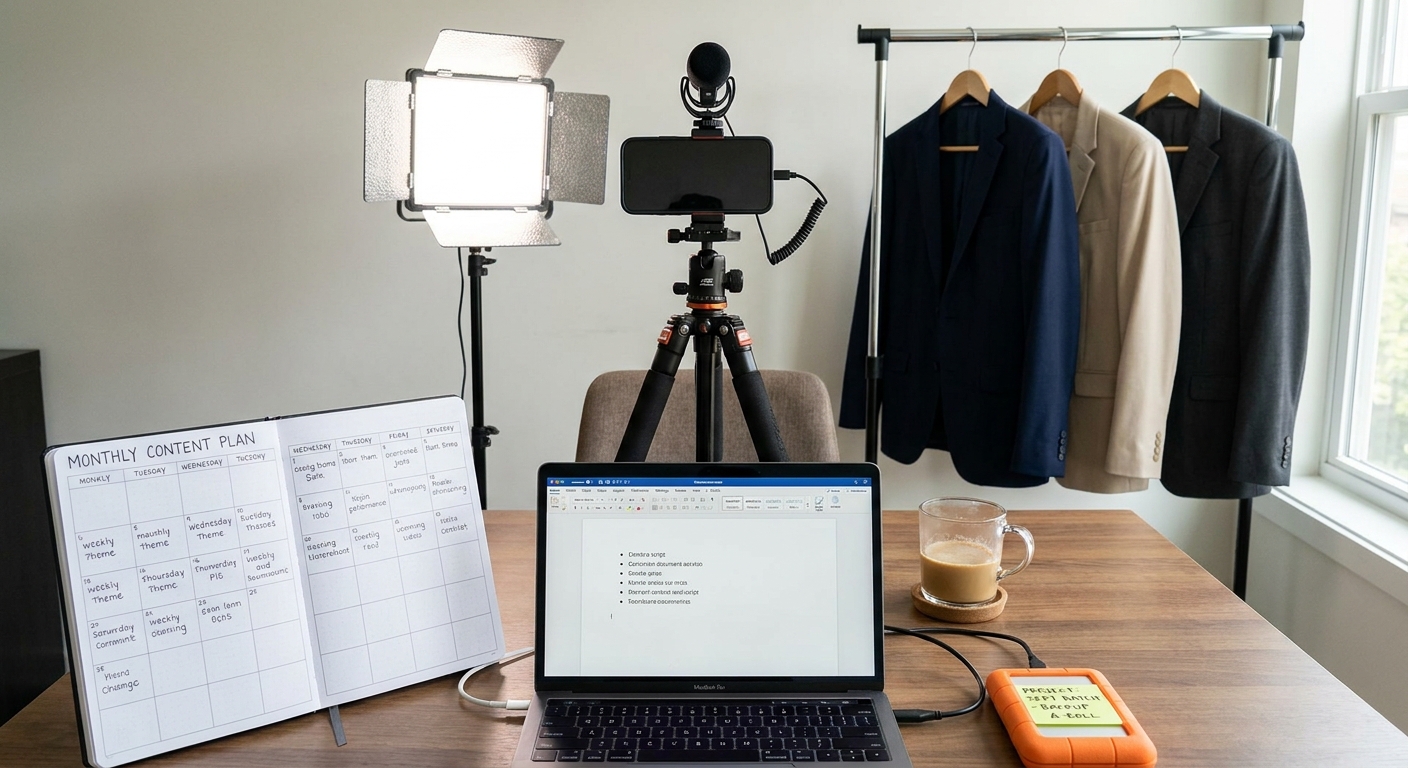
My process starts with Strategic Theme Planning. I pick one big theme for the month, then break it into four weekly mini-topics. This creates a beautiful, logical flow that your audience feels even if they never consciously notice it.
Next comes idea generation. My favorite method is embarrassingly simple: the “They Ask, You Answer” framework. I sit down and list every single question clients have asked me over the past year. Each question becomes a video. No staring at blank pages. No wondering what to talk about.
Finally, I write Minimalist Scripts. We’re not writing Shakespeare here. Three to five bullet points per video is plenty. This keeps you on track while leaving plenty of room for your natural personality to shine through. The moment your scripting starts sounding like an essay, you’ve gone too far.
Do this prep work properly and your filming day feels almost effortless.
Phase 2: Setting the Stage (The Day Before)
The day before my batching day, I build what I call a Batching Station.
Think of it as creating a backstage area that removes every possible point of friction. I gather my gear (phone, tripod, microphone, light), make sure everything is charged, and do a background check through my camera.
I also pre-select three or four simple wardrobe options — usually different blazers or shirts. A quick change between blocks gives each week’s videos a fresh look without complicating the day.
My unbreakable rule: filming day is for performance, not preparation.
Phase 3: The A-Roll Power Block (9am–Noon)
This is where the magic happens.
I start with my Week 1 outfit and film every video for that week. Then I do a quick change and move to Week 2. The momentum is incredible.
Pro tip: Before every take, give a sharp clap right in front of the camera. That spike makes syncing with B-roll ridiculously easy for your editor (or future you).
You don’t need perfection on the first take. Some of my best videos came from the third attempt when I finally relaxed and got into a groove. If you stumble, just smile, reset, and go again. We’re capturing energy, not robotic perfection.
Phase 4: The Creative Spark Session (Afternoon)
After a proper lunch and a quick walk, I shift gears.
This is when I film B-roll, product close-ups, screen recordings, and environmental shots. I also knock out thumbnails while I’m in the zone — intentionally leaving space in the frame so I can add text later.
Finally, I record a few reusable calls-to-action (“Don’t forget to subscribe,” “Comment below with your biggest takeaway,” etc.). These become part of my asset library and save massive time later.
Phase 5: The Golden Hour (Never Skip This)
This is my non-negotiable.
The last 45–60 minutes of the day, the camera goes away. This is purely for data management.
I immediately offload every file to an external drive and use a consistent naming system: YYYY-MM-DD_Topic_ARoll_Take2. It feels a little obsessive when you’re doing it, but it saves hours of frustration later.
This step turns potential chaos into a beautifully organized library. Future-you will send present-you a thank-you card.
Phase 6: The Post-Production Assembly Line
Here’s where most people go wrong.
The temptation is to edit one video completely before moving to the next. Resist it. Instead, treat editing like an assembly line:
- Rough cuts for all videos first
- B-roll and graphics pass
- Color correction and audio sweep
- Captions batch (the final step)
I’ve built a branded template in my editing software with my intro, outro, colors, and music already loaded. This single move cuts my editing time by more than half.
Phase 7: Scheduling & Autopilot
Once the videos are exported, I carve out one final focused block to upload everything into my scheduling tool.
Using those minimalist scripts I created at the beginning, I write compelling captions. I prepare my hashtag sets for the month. In about an hour, every post is loaded, captioned, and scheduled.
The feeling when you finish this step is incredible. You’ve just bought yourself weeks of mental space.
The Real Return on Investment
This isn’t just about saving time.
When you batch effectively, you show up as a better version of yourself on camera. Your energy is higher. Your ideas are clearer. Your content feels more cohesive.
You stop playing constant catch-up and start operating like someone who has their act together — because you do.
Ready to try your first One-Day Batching Blueprint?
Start small. Maybe batch just two weeks of content first. The system scales beautifully once you’ve done it a couple of times.
I’d love to hear how this lands for you. Drop a comment below: What’s the biggest obstacle stopping you from batching your content right now?
And mark your calendar — next week we’re going next level. In Episode 10, we’re diving into “AI in Your Workflow: Tools That Automate Video Creation & Editing.” The combination of smart batching plus strategic AI is genuinely ridiculous. You won’t want to miss it.
Until then, keep creating with intention.
Press Play,
Your Video Advantage Coach
P.S. If you found this helpful, share it with one entrepreneur who’s drowning in content creation. Let’s spread the batching gospel.