Hello and a huge welcome back to Press Play: Your SME Video Advantage.
It’s fantastic to have you here. Today we’re pulling back the curtain on something that feels like a mysterious black box to most business owners: social media algorithms.
My mission in this episode is simple — completely demystify them. So let’s talk about why these platforms treat video like their golden child, and more importantly, how your SME can ride that wave instead of watching it pass you by.
Take a quick look at your own feed right now. What do you see? Video. Video. And more video.
This isn’t random. It’s not a trend. It’s strategic, calculated, and incredibly smart on their part. Once you understand why video gets special treatment, everything changes. You stop creating content in the dark and start making decisions with the algorithm working for you instead of against you.
So grab your favorite drink, settle in, and let’s break this down together.
The Attention Economy (Yes, You’re the Product)
Here’s the foundational truth I want you to burn into your brain: these platforms aren’t charities. They’re businesses. And their product isn’t cute filters or clever features.
Their product is your attention.
Welcome to the attention economy, my friends. Every second you spend scrolling is currency. In this marketplace, a static image might be worth a dollar. A compelling video? That’s a platinum card.
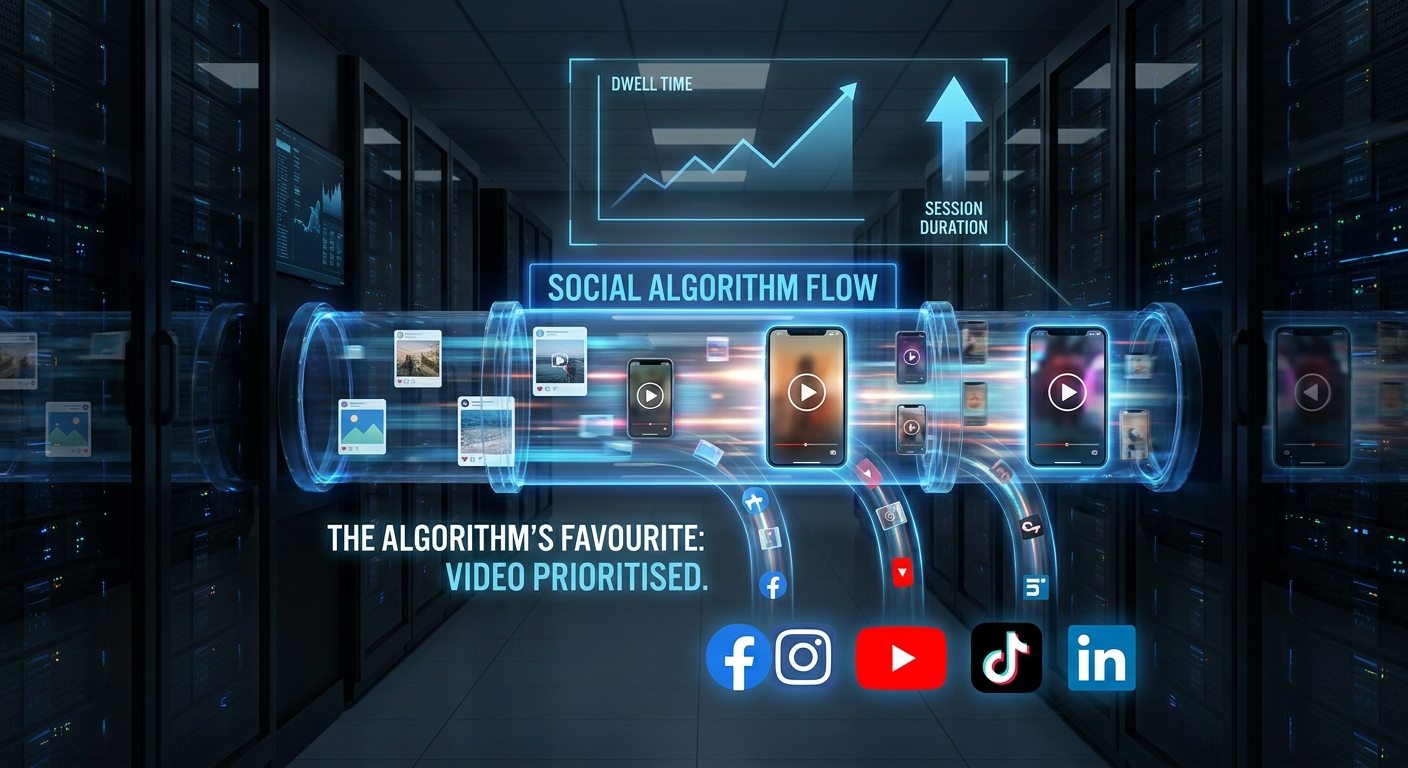
Why? Because video dominates the two metrics platforms obsess over: session duration (how long you stay in the app) and dwell time (how long you linger on one piece of content).
You can swipe past twenty photos in ten seconds. But a video that makes you stop, smile, think, or laugh? That’s pure gold to the algorithm. It keeps you in the app longer, which means more opportunities to show you ads.
I tell my clients this all the time: stop thinking of these platforms as content libraries. Start seeing them as casinos — and video is the house’s favorite game.
The Data Goldmine Hidden in Every Video
This is where most businesses get it wrong.
They chase likes like they’re going out of style. I get it — that little red heart feels validating. But a like on a photo is basically a whisper. A video gives the platform an entire conversation.
Think about the rich data a video creates:
- Watch time — how long someone actually watched
- Audience retention — the exact moment people drop off (painfully honest feedback)
- Re-watches — when someone loops back to watch something again
- Completion rate — the holy grail. Someone watching your entire video is like them saying, “Yes! More of this please!”
It’s the difference between someone waving at you from across the street versus inviting you in for coffee. One is polite acknowledgment. The other is genuine connection.
My personal rule of thumb: If your video doesn’t generate meaningful watch time, the algorithm will eventually stop showing it to new people. Full stop.
The Psychology That Makes Video Irresistible
The reason video performs so well isn’t just technical — it’s deeply human.
Our brains are hardwired to pay attention to motion. It’s a survival instinct leftover from when sudden movement in the grass might have been a lion. Add well-timed audio that sets a mood and a story that pulls us in, and you’ve created something almost hypnotic.
Here’s what fascinates me: you can feel more connected to a brand after watching one 30-second video than after seeing ten of their photos. Video creates emotional transportation.
Plus, it offers what I call passive consumption. Reading a long post requires mental effort. Watching a video? That’s low-effort, high-reward. Your brain gets a nice little dopamine hit without having to work too hard. That’s why you can lose 47 minutes on Reels before you realize what happened.
The Platforms Don’t All Play the Same Game
One of the biggest mistakes I see is treating every platform like it’s the same. They’re not.
Meta (Instagram & Facebook): They’re absolutely obsessed with Reels. Their algorithm is built for discoverability. A great Reel can reach thousands of people who don’t follow you. It’s pure entertainment-first.
YouTube: This is the marathon runner. Their algorithm isn’t just trying to serve one video — it’s trying to keep you in a “rabbit hole” for an entire evening. My advice here is always to think in connected series. One video should logically lead to the next.
TikTok: The great democratizer. It uses a “content graph” rather than a social graph. Size of following matters far less than the quality of your video. I’ve seen brand new accounts get millions of views on their very first video. It’s both terrifying and incredibly exciting.
LinkedIn: The quiet champion of authentic video. This isn’t the place for dance trends. It’s where you humanize your expertise. A simple, genuine video explaining an industry insight can build massive trust and keep professionals on the platform much longer than another text post.
The Power of “Passive Engagement”
Let me share something that might comfort you.
You post a video. The views climb nicely, but the likes and comments feel… quiet. It’s easy to feel discouraged. I’ve been there too.
Here’s what I want you to remember: a silent view is often more valuable than a like.
A like takes half a second. Someone watching your entire video without commenting? That’s a massive signal. They’re not just acknowledging your content — they’re consuming it. The algorithm notices.
This is what I call passive engagement, and it’s one of the most misunderstood concepts in social media.
Warning: Don’t fall into the painfully common trap of judging your content’s success by visible engagement metrics alone. The algorithm is watching what people actually do, not just what they tap.
How to Make the Algorithm Your Friend
Alright, let’s get practical. Here’s my simple framework for making it easy for platforms to love your content:
1. Win the first three seconds.
This is non-negotiable. Start with a bold question, a surprising visual, or a strong statement. Think of it as the handshake at the beginning of a conversation. Make it count.
2. Assume sound is off.
I put captions on everything. Not just accessibility captions — big, bold, readable text that tells the story even without audio. This is now table stakes.
3. Create “saveable” content.
Videos that contain checklists, frameworks, how-to guides, or valuable references get saved. Saves are powerful signals that your content has lasting value.
4. End with intentional engagement.
Instead of the lazy “What do you think?” try specific questions: “What would you add to this list?” or “Have you ever experienced this?” Specific questions get specific answers.
The Future (and What Will Never Change)
Looking ahead, things are only getting more sophisticated. AI-driven personalization will make our feeds feel almost psychic. We’ll see more interactive elements inside videos, polls, quizzes, and live shopping experiences that turn views directly into sales.
The goalposts will keep moving. They always do.
But here’s what I always come back to with my clients: the technology changes, but the mission doesn’t. The algorithm’s job is to keep people on the platform. Your job is to create genuine value that makes someone willingly give their attention.
Do that consistently, and you’ll always have a seat at the table.
So there you have it — the real reason video has become the algorithm’s favorite child.
It’s not magic. It’s not luck. It’s psychology, data, and business strategy all working together.
Understanding this “why” is the crucial first step. Next week we’re getting extremely practical in Episode 3: Your First 90 Days – A Realistic Video Strategy Blueprint. I’ll lay out a manageable, step-by-step plan designed specifically for SMEs who don’t have massive budgets or full-time video teams.
You’ll finally have a clear roadmap instead of throwing content into the void hoping something sticks.
In the meantime, I’d love to hear from you.
What’s one thing you’ve noticed about how video performs on your favorite platform? Have you had a video outperform everything else for seemingly no reason? Drop your thoughts in the comments — I read every single one.
Until next time, keep creating with intention.
Press play. Stay curious. See you in Episode 3.
— Your Video Advantage Coach